


Is 100% Cotton Breathable? The Full Fabric Guide
Table of Contents
- What 'Breathable' Actually Means in Fabric Science
- Why 100% Cotton Is Breathable, and When It Isn't
- Moisture Absorption vs. Moisture Wicking in Cotton
- Polyester vs Cotton Breathability: A Direct Comparison
- Best Breathable Fabrics for Hot Weather, Ranked
- How to Tell If a Cotton Garment Will Actually Keep You Cool
- Layering Cotton in Warm Climates: What Actually Works
- Conclusion
Last Updated: August 14, 2026
What 'Breathable' Actually Means in Fabric Science
Breathability is the ability of a fabric to allow air, moisture vapor, and heat to pass through it, preventing warmth and humidity buildup against the skin. A fabric earns that label through the interaction of fiber type, weave structure, fabric weight, and surface finish.
The technical term is air permeability: how freely air molecules move through the cloth's porous structure. High air permeability allows convective cooling, so body heat dissipates rather than accumulating beneath the garment. Moisture management is equally critical, a fabric can be highly permeable to air but still feel clammy if it traps moisture vapor instead of releasing it.
At Lotus Temple Collection, we work exclusively with 100% cotton and organically sourced materials, so understanding what makes cotton breathable is central to how we design every piece. Below, we'll break down the technical variables that determine airflow, explain when cotton performs brilliantly and when it struggles, and give you a practical framework for choosing garments that will genuinely keep you cool.
USDA Agricultural Research Service overview of natural fiber properties
Why 100% Cotton Is Breathable, and When It Isn't
Cotton is breathable because its fibers are hydrophilic, they readily absorb moisture, and its natural structure creates a porous fabric surface with meaningful air permeability. A plain-weave cotton shirt allows body heat to escape and pulls perspiration away from the skin through absorption, which is why cotton has been the warm-weather fabric of choice across cultures for centuries.
But not all cotton is equally breathable. The fiber itself is only the starting point. Construction, weight, and finish determine whether a cotton garment will feel like a cool breeze or a damp second skin. A tightly woven cotton canvas and a loosely woven cotton voile are both 100% cotton, yet one traps heat while the other barely feels like wearing fabric at all.
Cotton also has one genuine limitation: once it absorbs moisture, it holds it. Unlike synthetic wicking fibers, saturated cotton dries slowly. In high-humidity conditions with intense physical activity, a cotton garment can shift from pleasantly absorbent to heavy and clingy. For gentle resort wear and beach cover-ups, this is rarely a problem.
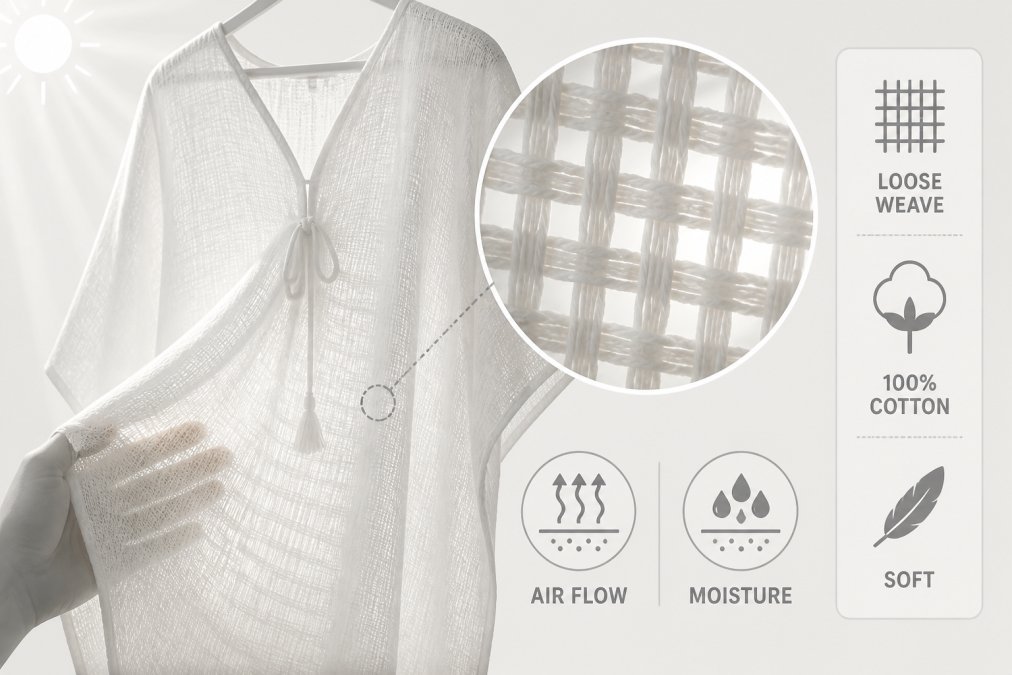
How Weave Density and Construction Control Airflow
Weave density is the single most decisive factor in how breathable a cotton garment actually is. Yarn count and weave structure determine the size and number of pores in the fabric, and those pores are what air passes through.
A plain weave with low thread count, like muslin or cheesecloth, has large open pores and exceptional air permeability. A sateen weave with high thread count has tightly interlocked yarns that reduce porosity significantly, even though the fiber content is identical. Voile and lawn cotton sit at the breathable extreme; twill and canvas sit at the other end.
When shopping for warm-weather cotton, look for fabrics described as voile, lawn, gauze, or muslin. These weave constructions prioritize airflow. Percale and poplin sit in the middle. Sateen and high-thread-count cotton sacrifice breathability for smoothness.
GSM: The Weight Factor Most People Overlook
GSM, or grams per square meter, measures how much material is packed into a given area of fabric. It is one of the most reliable indicators of how a garment will perform in heat, yet most product listings don't mention it.
As a general guide:
- 80-120 GSM, Lightweight, highly breathable; ideal for hot and humid climates.
- 130-180 GSM, Medium weight; comfortable in warm weather, versatile across seasons.
- 180-250 GSM, Heavier cotton; better suited to cooler temperatures.
- 250+ GSM, Dense, insulating; not appropriate for warm-weather wear.
Kaftans and tunics designed for beach and resort use typically fall in the 80-130 GSM range. If a brand doesn't list GSM, hold the fabric up to light. If light passes through easily, you're looking at a lightweight, breathable construction.
How Dyes and Finishes Affect Air Permeability
Chemical finishes applied to cotton, including wrinkle-resistant treatments and stain guards, can partially block the micro-pores in the fabric structure. A heavily treated cotton can lose measurable air permeability even though the fiber content hasn't changed. This is why a chemically finished "easy-care" cotton shirt can feel stuffier than an untreated organic cotton garment of the same weight.
Dye type also plays a role. Reactive dyes, commonly used on organic cotton, bond at the molecular level without adding a surface coating. Pigment dyes sit on the fabric surface and can reduce porosity slightly. For maximum breathability, untreated or minimally finished cotton using reactive or natural dyes performs best.
Hand block-printing, as practiced in traditional textile artisanship, uses natural or reactive dyes applied by hand in a process that preserves the fabric's open structure far better than industrial printing methods.
Moisture Absorption vs. Moisture Wicking in Cotton
Most people confuse these two mechanisms, leading to poor fabric choices.
Moisture absorption is what cotton does naturally. Its hydrophilic fibers pull moisture into the fiber structure itself, drawing sweat away from the skin surface. This feels comfortable initially because the skin stays dry. The limitation is capacity: once the fiber is saturated, absorption stops, and the fabric feels heavy.
Moisture wicking is what synthetic fibers like polyester do. Wicking fabrics don't absorb moisture into the fiber; they transport it across the fabric surface through capillary action, spreading it over a larger area where it evaporates faster.
For warm-weather resort wear and casual use, cotton's absorption mechanism is generally more comfortable. The moisture goes into the fiber, the skin stays dry, and light airflow through the open weave promotes evaporative cooling. Cotton struggles in sustained high-heat activity where sweat output exceeds the fabric's absorption capacity.
Polyester vs Cotton Breathability: A Direct Comparison
The polyester vs cotton breathability debate has a clear answer for most warm-weather and casual use cases: cotton wins on comfort, and polyester wins on performance metrics.
| Property | 100% Cotton | Polyester | Cotton-Poly Blend |
|---|---|---|---|
| Air permeability | High (weave-dependent) | Low to moderate | Moderate |
| Moisture management | Absorbs into fiber | Wicks across surface | Mixed |
| Drying speed | Slow | Fast | Moderate |
| Feel against skin | Soft, natural | Can feel synthetic | Varies |
| Heat dissipation | Good | Poor in high heat | Moderate |
| Best use case | Resort, casual, retreat | Athletic performance | Everyday versatile |
Polyester's hydrophobic fiber structure means moisture cannot be absorbed into the fiber itself. Instead, it moves along the fiber surface, making polyester fast-drying but poor at actual heat dissipation in still air. Cotton's thermal regulation in warm, low-activity environments consistently outperforms polyester because the open fiber structure allows heat to escape and moisture to absorb.
A common mistake is assuming polyester's "moisture-wicking" label makes it cooler than cotton. In a beach setting or at a resort, a lightweight cotton kaftan will feel significantly more comfortable than a polyester equivalent of the same weight.
Cotton-polyester blends offer a compromise: faster drying than pure cotton, more natural feel than pure polyester. They work well for everyday casual wear but don't reach the breathability ceiling of a fine, lightweight 100% cotton weave.
Best Breathable Fabrics for Hot Weather, Ranked
Not all natural fibers perform equally in heat. Here's how the main options compare for genuine warm-weather comfort.
- Cotton voile / lawn (100% cotton, fine weave), The top performer for resort and casual wear. Exceptional air permeability, soft hand-feel, and natural moisture absorption. Ideal GSM range: 80-120.
- Linen, Highly breathable with a slightly coarser texture. Linen's hollow fiber structure allows excellent airflow.
- Rayon / Viscose, Made from plant cellulose, rayon is lightweight and drapes beautifully. It absorbs moisture well but weakens when wet.
- Bamboo fabric, Soft, breathable, and naturally moisture-wicking. Bamboo-derived fabrics have grown in popularity for resort wear.
- Cotton-linen blends, Combine cotton's softness with linen's airflow. A strong choice for warm-weather garments.
- Polyester (performance weave), Ranks here only for high-activity contexts. For resort and casual wear, it sits below every natural fiber option on comfort.
- Nylon, Durable and quick-drying but poor at heat dissipation. Best suited to swimwear and activewear.
For beach cover-ups, kaftans, and resort tunics, options 1 through 3 are most relevant. A lightweight 100% cotton voile or lawn fabric remains the gold standard for the combination of breathability, comfort, and aesthetic versatility.
Textile Exchange overview of natural and organic fiber properties
How to Tell If a Cotton Garment Will Actually Keep You Cool
The label says "100% cotton" but that tells you almost nothing about how it will actually perform. Here are the tests you can run before committing to a purchase.
Visual and Touch Tests You Can Do Before Buying
1. The light test. Hold the fabric up to a window or light source. A breathable, lightweight cotton will allow light to pass through clearly, revealing the open weave structure. Dense, heavy cotton blocks light almost entirely.
2. The drape test. Let the fabric fall from your hand. Lightweight, breathable cotton has a fluid drape; it falls softly and moves easily. For warm-weather wear, you want the former.
3. The scrunch test. Scrunch a section of fabric in your fist, hold for five seconds, then release. Lightweight cotton will recover quickly and show minimal creasing.
4. The texture check. Run the fabric between your fingers. Fine-yarn cotton with an open weave feels almost weightless. A smooth, silky finish often indicates a sateen weave or surface treatment that may reduce breathability.
5. Check for GSM or weight descriptors. If the product listing mentions "lightweight," "voile," "lawn," "gauze," or a GSM under 130, those are positive indicators. Terms like "structured," "heavy," or "canvas-weight" signal lower breathability.
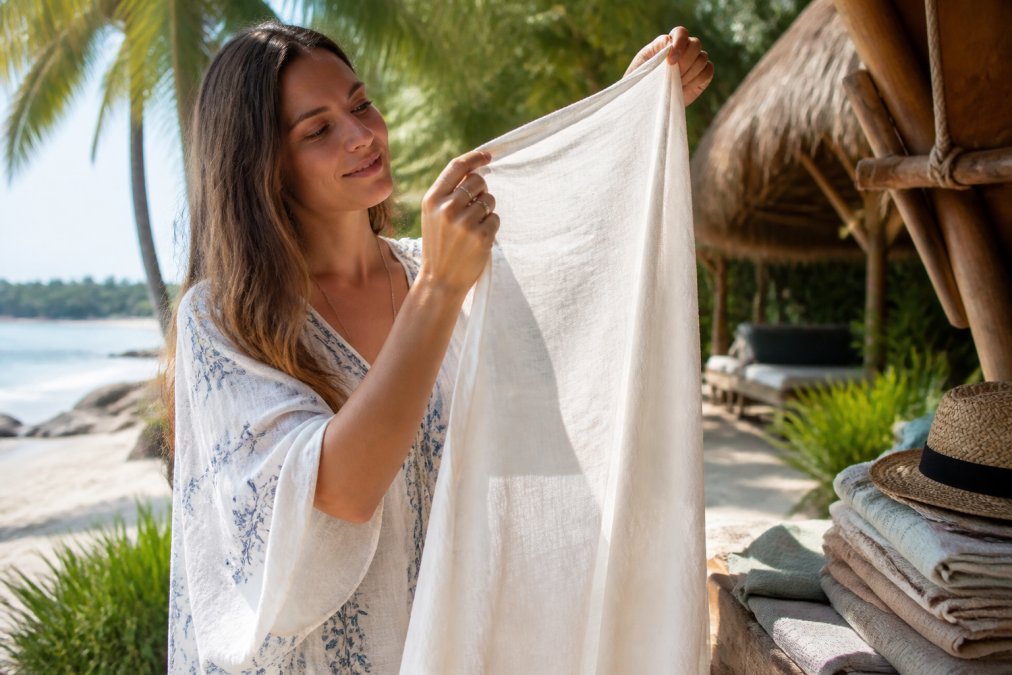
Customer Beth Carter Bell, an artist based in Florida, describes her Lotus Temple Collection kaftans as "perfect for HOT Florida", which is exactly the use case these visual tests are designed to help you identify before buying.
Layering Cotton in Warm Climates: What Actually Works
Layering in heat sounds counterintuitive, but the science supports it when done correctly. A single dense layer traps heat more effectively than two thin layers with an air gap between them. That air gap acts as a thermal buffer, allowing heat to dissipate before it reaches the outer garment. A lightweight cotton kimono worn over a cotton camisole can feel cooler than a single medium-weight cotton tee.
The layering rules for warm climates:
- Keep each layer under 120 GSM. Two layers at 100 GSM each create less heat retention than a single layer at 180 GSM.
- Use the same fiber for both layers. Cotton over cotton allows moisture to transfer consistently between layers.
- Prioritize loose construction. A kaftan or tunic with a relaxed fit creates natural air channels between the body and the fabric.
- Choose light colors for the outer layer. Lighter colors reflect radiant heat rather than absorbing it.
- Avoid layering over synthetic base layers in high humidity. Synthetic fibers trap moisture at the skin surface; cotton absorbs it.
The resort kaftan worn over a lightweight cotton slip is a classic warm-climate layering combination precisely because it works. The outer layer provides coverage and style; the air gap between the layers promotes continuous airflow and heat dissipation.
Choosing the right cotton garment for heat and humidity comes down to more than fiber content. Weave construction, GSM, finish, and fit all determine whether a piece will keep you genuinely comfortable. Lotus Temple Collection's hand block-printed kaftans and resort tunics are designed with exactly these variables in mind: lightweight organic cotton, open weave constructions, and natural reactive dyes that preserve the fabric's air permeability. If you're looking for warm-weather pieces that perform as well as they look, explore the collection and find the right weight and weave for your climate.
Frequently Asked Questions
Is 100% cotton too hot for summer?
100% cotton is not inherently hot for summer, the weave, weight, and construction determine comfort. A loosely woven, low-GSM cotton like voile or muslin allows strong airflow and evaporative cooling. Heavier cotton fabrics, such as canvas or thick jersey, trap heat more than lighter weaves. For summer, look for cotton garments under 150 GSM with an open weave structure. These stay genuinely cool even in humid conditions.
Does 100% cotton trap sweat?
Cotton absorbs moisture rather than wicking it away. Its hydrophilic fibers pull sweat from your skin, which initially feels cooling as the moisture evaporates. In high humidity, where evaporation slows, saturated cotton can feel damp and heavy. This differs from synthetic moisture-wicking fabrics that move sweat to the fabric surface faster. For tropical or beach settings, loose-cut cotton garments compensate for slower evaporation by allowing airflow around the body.
Is 100% cotton as breathable as linen?
Linen generally outperforms cotton on breathability because its longer, coarser fibers create a more open fabric structure with higher air permeability. Linen also absorbs moisture quickly and dries faster. That said, a fine, loosely woven cotton, like a cotton voile or gauze, comes close to linen in airflow. Cotton typically wins on softness and drape, making it more comfortable against skin for extended wear, especially in garments cut with generous volume.
How does weave affect the breathability of 100% cotton?
Weave structure directly controls how much air moves through a cotton fabric. Open weaves, like gauze, voile, or basket weave, create larger gaps between yarns, increasing porosity and airflow. Tight weaves like percale or twill reduce those gaps, lowering air permeability even when fiber composition is identical. Yarn count also matters: a higher thread count in a tight weave can actually trap more heat, which is why thread count alone is a poor guide to breathability in cotton garments.
This article was written using GrandRanker